

A month of findings
- Alerts raised
- 1,000
- Reviewed by the team
- 30
- Analyst time spent
- half a day
- Controls actually applied
- unrecorded
Every finding arrives as work for a human who is already behind.
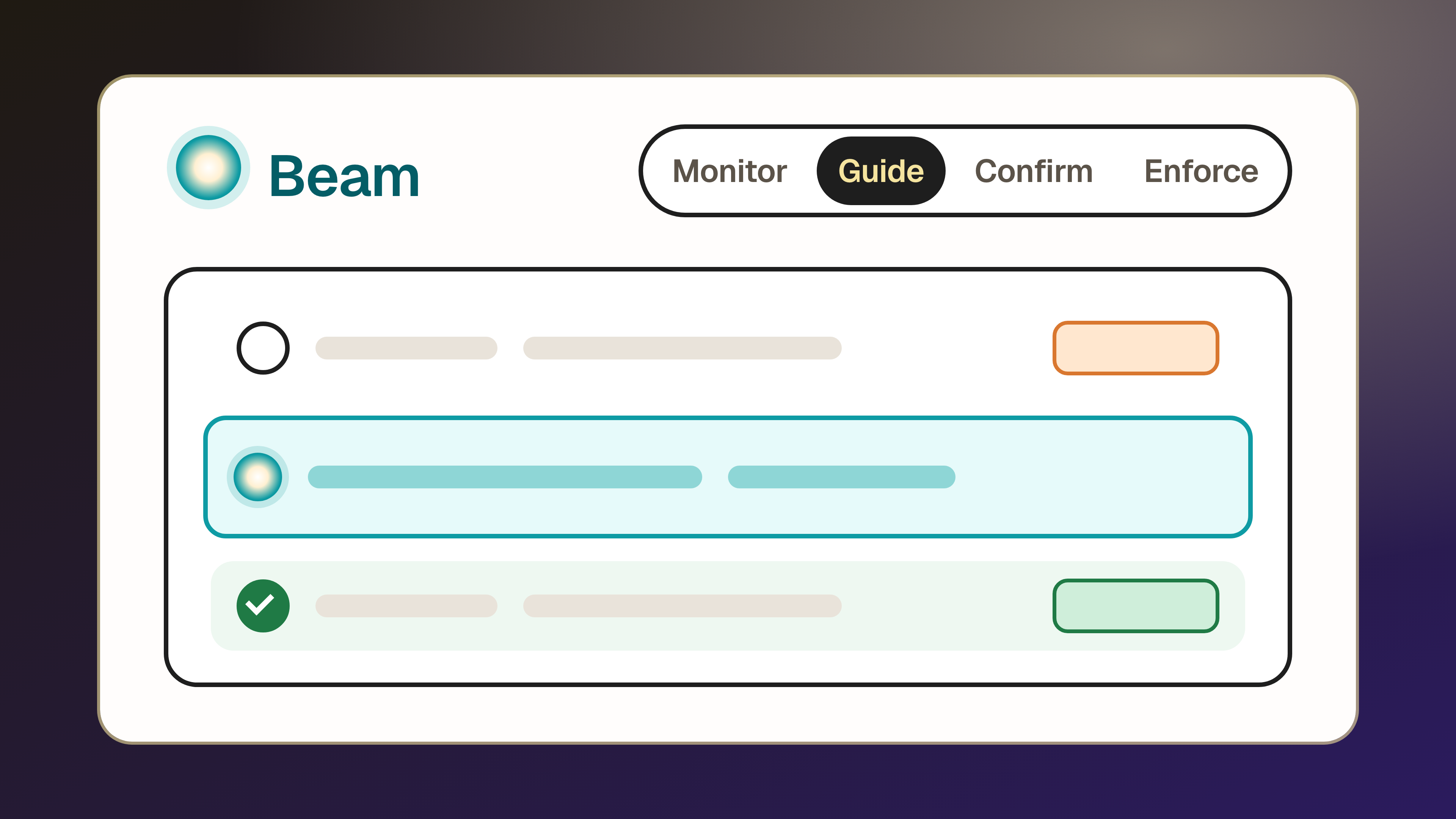
Beam: Remediation
Beam guides agent decisions in real time, keeping activity aligned with enterprise policy without slowing your builders down. Start in monitor mode, enforce when you are confident.









And dozens more
A month of findings
Every finding arrives as work for a human who is already behind.
The same month, with Beam
Geordie’s inline remediation engine, Beam, shapes agent behavior in real time through context engineering, deployed via agent-native and harness-native mechanisms including lifecycle hooks, plugins, and MCP. Responses are context-specific and escalate with risk.
Beam watches the action and writes it to the immutable record without touching it. The agent proceeds exactly as it would have, and the team gets the evidence it needs to decide whether anything stronger is warranted.
Beam writes additional context into the agent’s reasoning and offers an approved pathway. Nothing is blocked; an agent heading somewhere it is not authorized for is guided to an equivalent it is, and the work continues.
A new mode for the Claude ecosystem. The agent stops and waits for an explicit decision to continue or not. Beam delivers the context behind the pause to the agent, so whichever way the operator decides, the agent carries that context into what it does next.
Lifecycle hooks are binding. Prohibited actions and tool use do not execute, and the attempt is written to the immutable record.
Policy that adapts per agent, per department and per use case – not one blanket rule at a boundary.
read · customer_financials
Authorized to process financial data. Beam adds no friction and the work completes.
read · customer_financials
Not authorized. The agent is guided to an approved source and the campaign task still finishes.
Beam applies context engineering directly within the agent's reasoning process, deployed via lifecycle hooks, plugins, and MCP to shape behavior at the moment decisions are made. Controls that work this way run continuously – without the latency of external policy checks or the binary outcomes of gateway enforcement.
Where enforcement happens
Interception is enforcement. One point carries every agent.
Beam attaches to the agent's own execution path through lifecycle hooks, plugins, and MCP, reading config, context, and behavioral patterns directly rather than inspecting traffic from outside.
The deep analysis happens continuously, out of band. The inline response is fast because the context is already there.
Continuous analysis drawing on the full depth of an agent's history.
Detection and response applied in the moment, using the context the offline work already built.
“We're seeing the iceberg that rocked the Titanic — weeks in advance rather than the moment it appears on screen. We're able to take a snapshot of the entire ecosystem and have adult, grown-up conversations about what's responsible and what's not. We can quantify everything now.”


“My leadership team approved these tools because I could show them with Geordie what the agents were doing. Not what the model was doing. Not what the network was logging. What the agent was actually doing, step by step, on their behalf. That's the view that matters.”

“We've got Geordie deployed across at least 90% of our tech ecosystem now, and the visibility it gives me helps me articulate the return of control, the reduction of risk, and how well we're managing AI adoption.”

“Agentic AI technologies will enable the most significant delegation of data analysis, decision making and execution privileges ever seen. Coupled with the rapid adoption of MCP integrations, agentic AI is already a top risk for many companies. For us, Geordie gives us oversight & visibility - the first layer in any effective cyber defence.”

“We've been rolling out agentic AI across the business for a while now, and the governance question kept coming up: what's actually running, what can it do, and what happens if something goes wrong? Geordie is helping us solve these problems. It's given us real peace of mind, and they're improving their product every week. Geordie should be on every company's shortlist for agentic AI discovery and governance.”

“One of the key challenges for us was how to secure agentic AI in a practical and scalable way. Geordie's endpoint-based approach stood out because it gave us visibility close to where agent activity happens, without forcing us into a more complex gateway-based model. It gave us the balance of visibility, governance, and architectural simplicity.”

“We're seeing the iceberg that rocked the Titanic — weeks in advance rather than the moment it appears on screen. We're able to take a snapshot of the entire ecosystem and have adult, grown-up conversations about what's responsible and what's not. We can quantify everything now.”
“My leadership team approved these tools because I could show them with Geordie what the agents were doing. Not what the model was doing. Not what the network was logging. What the agent was actually doing, step by step, on their behalf. That's the view that matters.”
“We've got Geordie deployed across at least 90% of our tech ecosystem now, and the visibility it gives me helps me articulate the return of control, the reduction of risk, and how well we're managing AI adoption.”
“Agentic AI technologies will enable the most significant delegation of data analysis, decision making and execution privileges ever seen. Coupled with the rapid adoption of MCP integrations, agentic AI is already a top risk for many companies. For us, Geordie gives us oversight & visibility - the first layer in any effective cyber defence.”
“We've been rolling out agentic AI across the business for a while now, and the governance question kept coming up: what's actually running, what can it do, and what happens if something goes wrong? Geordie is helping us solve these problems. It's given us real peace of mind, and they're improving their product every week. Geordie should be on every company's shortlist for agentic AI discovery and governance.”
“One of the key challenges for us was how to secure agentic AI in a practical and scalable way. Geordie's endpoint-based approach stood out because it gave us visibility close to where agent activity happens, without forcing us into a more complex gateway-based model. It gave us the balance of visibility, governance, and architectural simplicity.”
“We're seeing the iceberg that rocked the Titanic — weeks in advance rather than the moment it appears on screen. We're able to take a snapshot of the entire ecosystem and have adult, grown-up conversations about what's responsible and what's not. We can quantify everything now.”
“My leadership team approved these tools because I could show them with Geordie what the agents were doing. Not what the model was doing. Not what the network was logging. What the agent was actually doing, step by step, on their behalf. That's the view that matters.”
“We've got Geordie deployed across at least 90% of our tech ecosystem now, and the visibility it gives me helps me articulate the return of control, the reduction of risk, and how well we're managing AI adoption.”
“Agentic AI technologies will enable the most significant delegation of data analysis, decision making and execution privileges ever seen. Coupled with the rapid adoption of MCP integrations, agentic AI is already a top risk for many companies. For us, Geordie gives us oversight & visibility - the first layer in any effective cyber defence.”
“We've been rolling out agentic AI across the business for a while now, and the governance question kept coming up: what's actually running, what can it do, and what happens if something goes wrong? Geordie is helping us solve these problems. It's given us real peace of mind, and they're improving their product every week. Geordie should be on every company's shortlist for agentic AI discovery and governance.”
“One of the key challenges for us was how to secure agentic AI in a practical and scalable way. Geordie's endpoint-based approach stood out because it gave us visibility close to where agent activity happens, without forcing us into a more complex gateway-based model. It gave us the balance of visibility, governance, and architectural simplicity.”
“We've been rolling out agentic AI across the business for a while now, and the governance question kept coming up: what's actually running, what can it do, and what happens if something goes wrong? Geordie is helping us solve these problems. It's given us real peace of mind, and they're improving their product every week. Geordie should be on every company's shortlist for agentic AI discovery and governance.”
Context engineering applied inside the agent's reasoning process, deployed via lifecycle hooks, plugins, and MCP to shape behavior at the moment decisions are made.
See how we handle your data in our Trust Center (opens in a new tab)
Your request has been received.
How do I reduce agent risk without stopping the work?
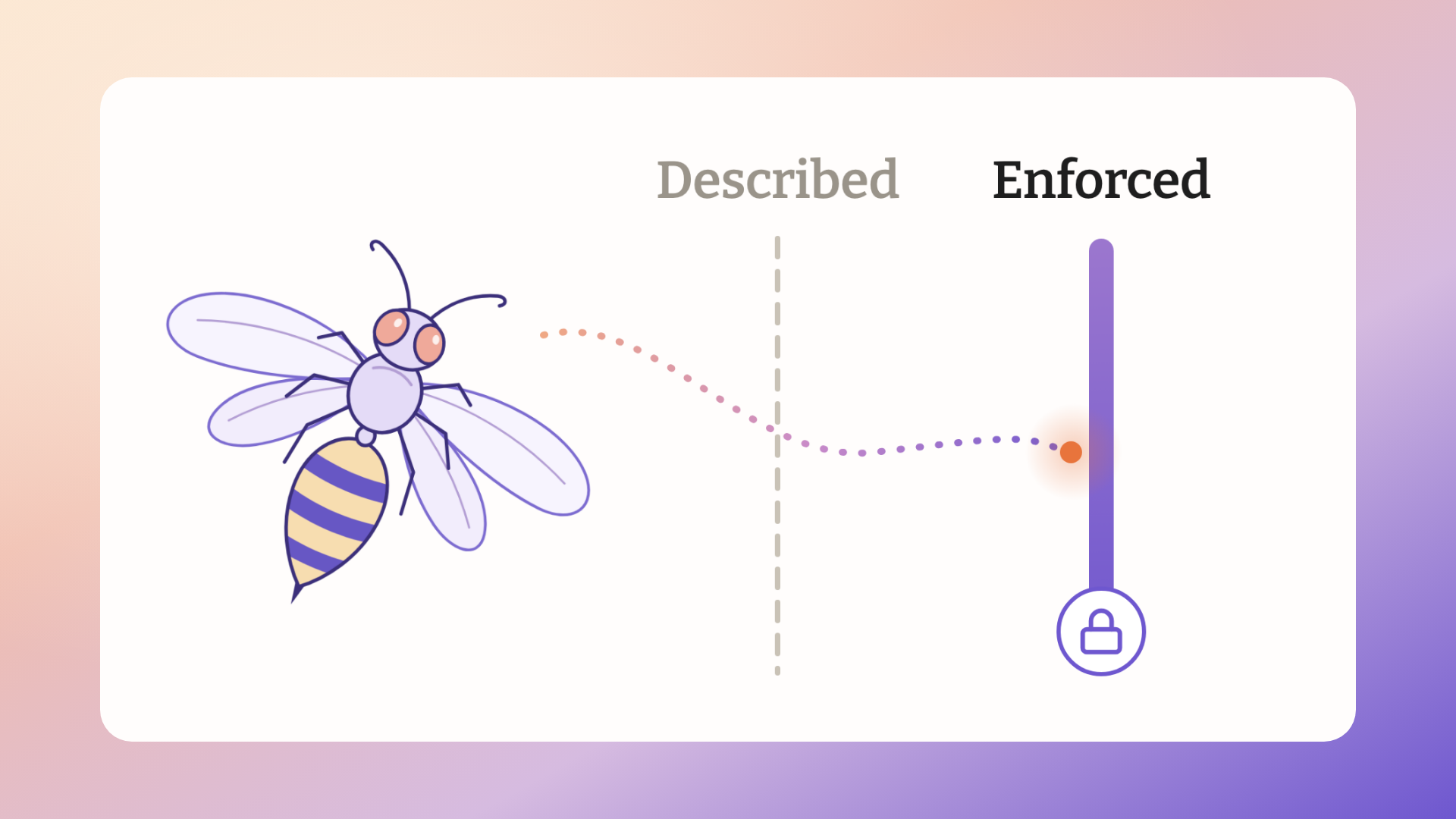
OWASP’s Q3 exploit roundup says prompt-level instructions alone do not establish a secure boundary.

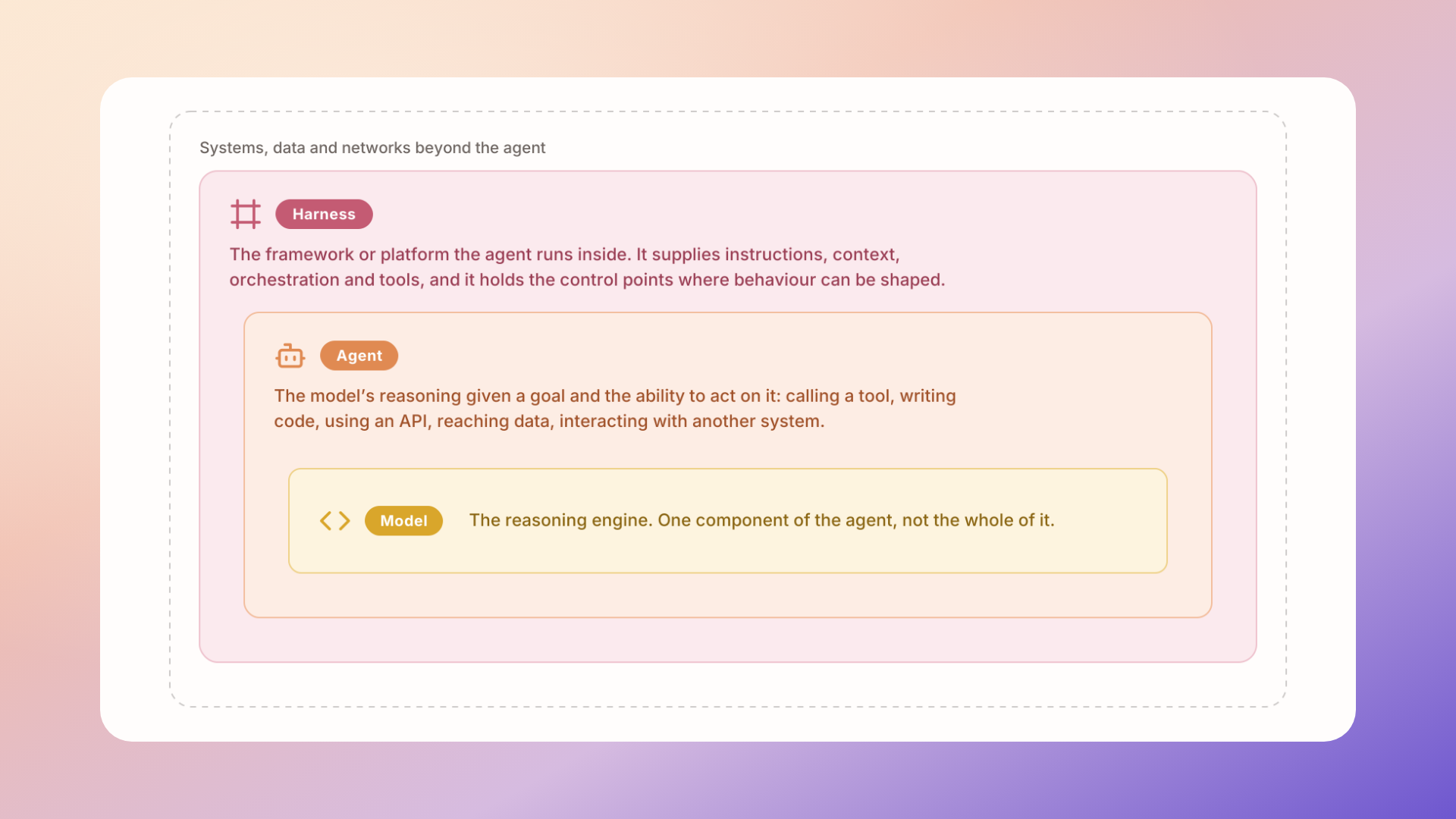
Model capability is one input to what an agent does.