









Five predictions for how AI value gets measured in 2027
Hanah Darley and Skillable's Jessica Zeba-Snow on how AI value measurement will change in 2027, from self-reported time savings to evidence of agent work.


Jessica Zeba-Snow brought Skillable’s first enterprise AI platform in-house in 2023, making the company an early adopter. At that stage, the measure that mattered was whether people would use it. The next two years were mostly about building trust in the safeguards and helping the habit spread beyond a handful of champions.
Over the past year, the behavioral shift reached all teams and adoption went from a steady climb to a sudden spike. Experimentation that once happened in controlled pockets became part of how every function works, first as AI-assisted work and now, deliberately, as AI-native work. Leadership now wants to know which of this work deserves to scale, what it costs, and how its value translates up, down and across the organization.
The same question turned Jessica’s early work on adoption into a long-running interest in how AI value gets measured, and it’s a common theme we hear at Geordie from AI and security leaders.
Why time saved became the default measure
Most of today’s measurement tools grew up in the same assistant era as Skillable’s first rollout, and for good reason. When AI was mostly an assistant, the burning question was how much time it gave back to the user. Tools such as Microsoft’s Copilot impact report answer this by turning AI actions into estimated hours and then into dollars.¹ Jessica built her own model on the same principle. It sets the value of the time returned against what the AI costs and gave her a value story that resonates with finance teams.
She also saw early where that model falls short. Earlier this year, Jessica was relying on minimal usage data and people to report their biggest AI wins each week. The reports covered everything from the two-hour saves to innovation and workflow change, but the picture was incomplete. “I knew that I was only capturing partial wins and soft estimates at best,” she says. The gap only widens with agents, because an agent working in the background produces value that nobody is prompted to report. This approach is now being extended to agents through an agent assisted hours metric that still translates their work back into the hours a person would have spent.²
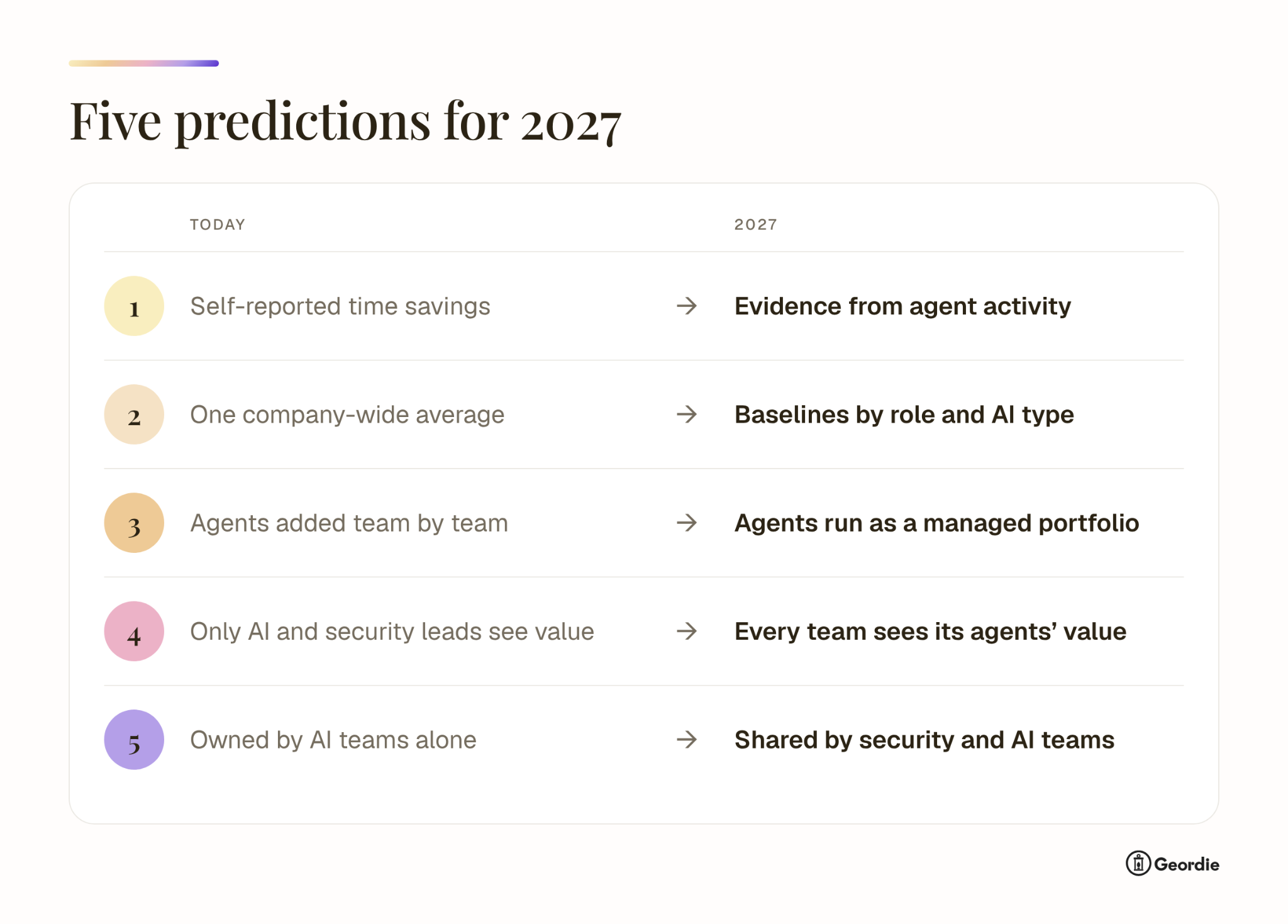
To get past self-reporting and estimated hours to the complete picture, the evidence has to come from what agents do in production; that’s the direction Jessica is taking at Skillable. Based on her insights and what we see across other organizations, we’ve curated our top five predictions in this piece for how AI value measurement will change over the next year.
Prediction 1: Evidence of agent work will replace self-reported time savings
In 2027, the burden of proof in AI business cases moves from survey responses to agent traces.
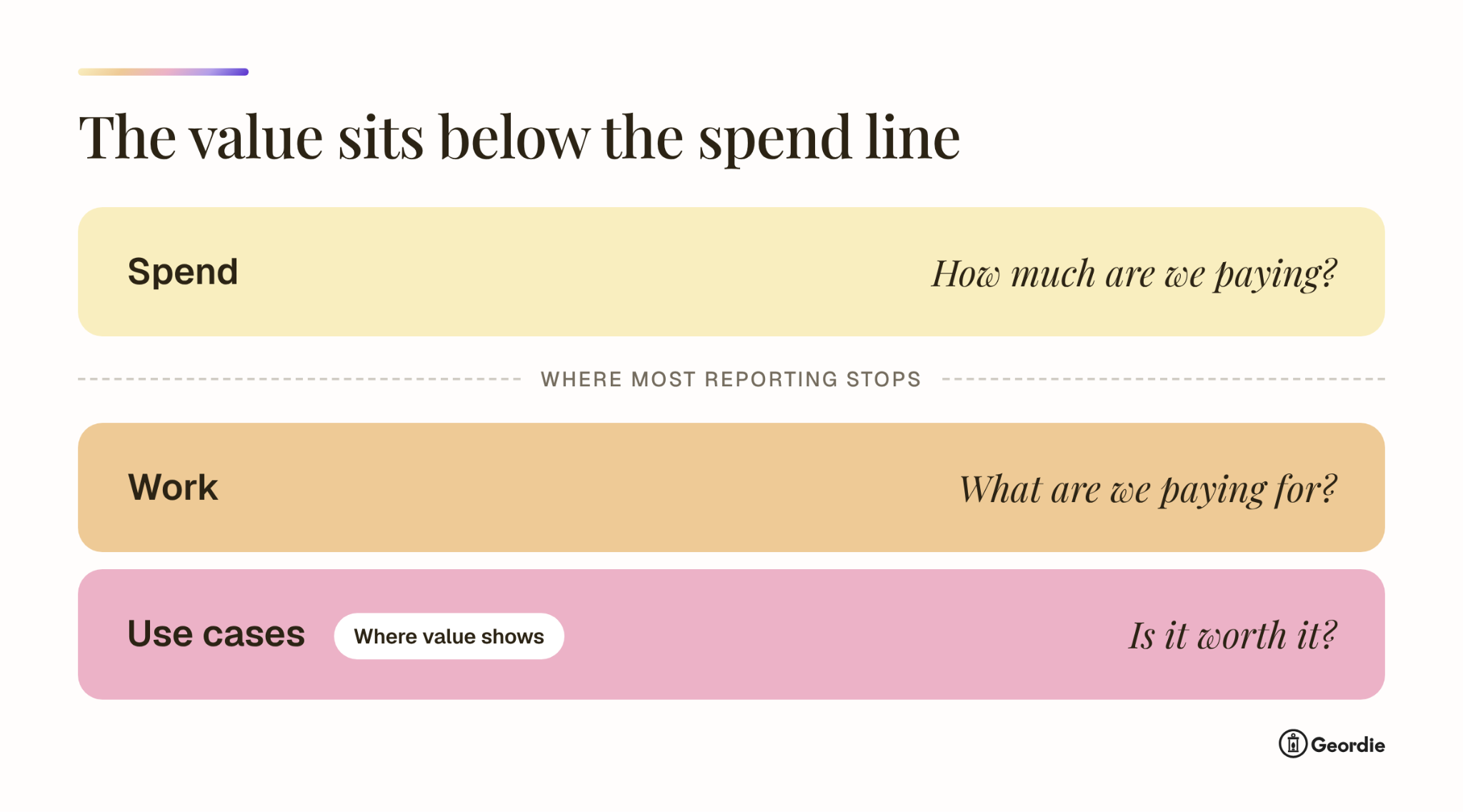
Agents leave a record of their work in a way people never did. Each run shows which agent acted, on whose behalf, which tools it called, what it consumed and what it produced. Classified by use case, that record shows what work actually happened, independent of what anyone remembered to report. Estimates will become one input checked against that evidence. At Skillable, agent activity data is the validation point for cost and agent runs in the ROI model. The bigger shift is in what becomes visible. Under self-reporting, an agent doing useful work in the background stays invisible; now it finally shows up in the value model.
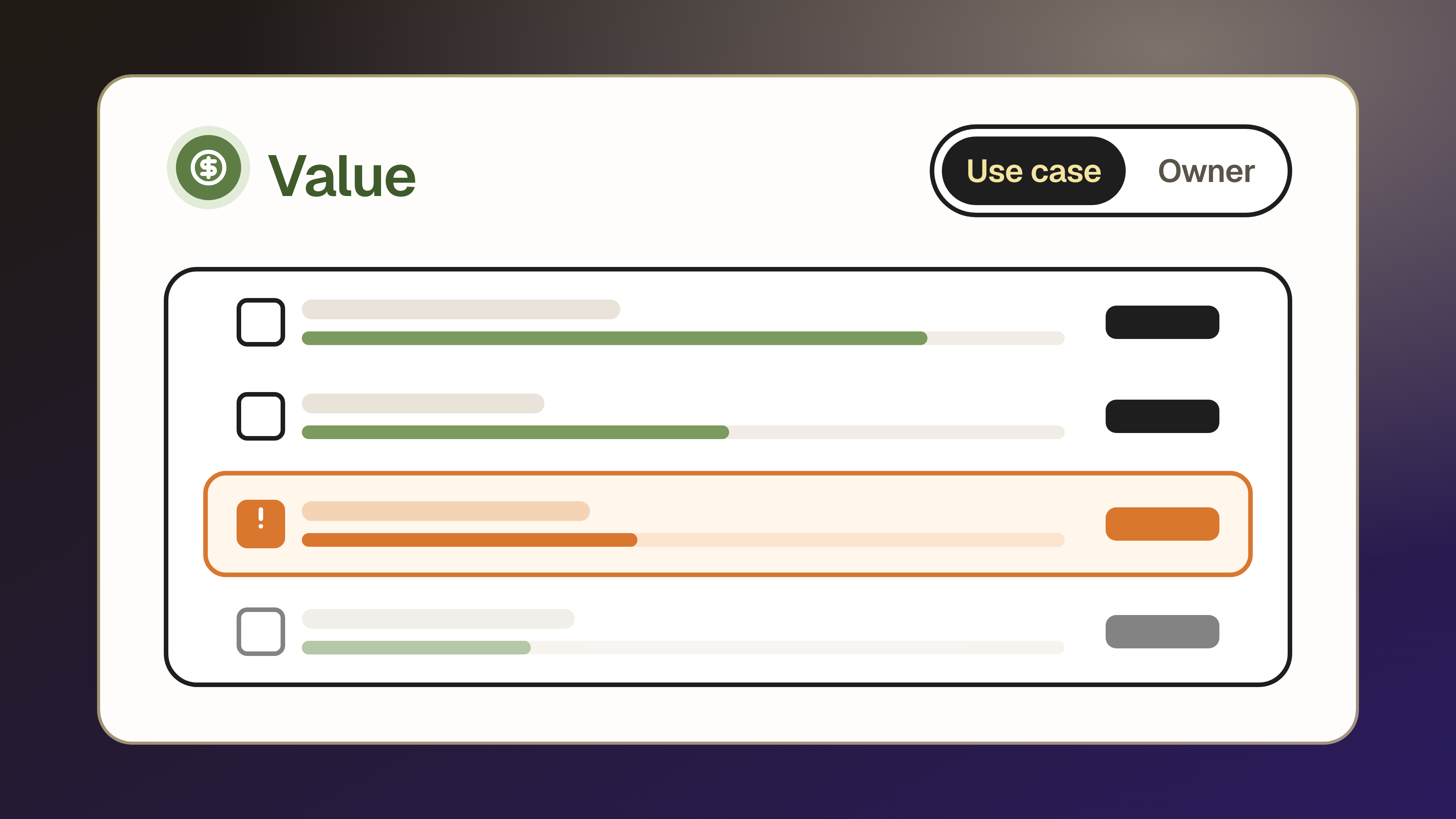
In practice, that evidence builds in layers: what agents spend, the specific work the spend buys, and the use cases that work adds up across the business. The last layer is where value becomes visible, because it shows leaders what they’re getting for the investment, down to who did the work and which models it ran on.
Prediction 2: Value models will split by role family and by type of AI
In 2027, value models will carry separate baselines by role family and by type of AI.
Skillable’s future-forward value model has already moved past a single organization-wide average. For engineering, it looks at what teams ship, measured against quality, alongside what the supporting AI costs. It also treats coding agents very differently from the generative AI that supports customer service. That distinction matters because AI doesn’t return the same value everywhere it’s used.
Separate baselines by role and AI type answer that question, and pairing quality measures with volume keeps them honest, because an agent given a single number to improve will usually find a way to improve it. The result is a more useful conversation with leadership, one about where AI works best and therefore where the next investment should go.
We’d add one more dimension to those baselines, which is efficiency: how much spend an agent needs to produce a unit of useful work. A high-volume agent can look expensive on tokens alone and still be one of the best investments in the estate, and only a measure that blends cost with the work produced will show it.
Prediction 3: Agent estates will be managed like a product portfolio
In 2027, leading organizations will manage their agents the way a product team manages a portfolio.
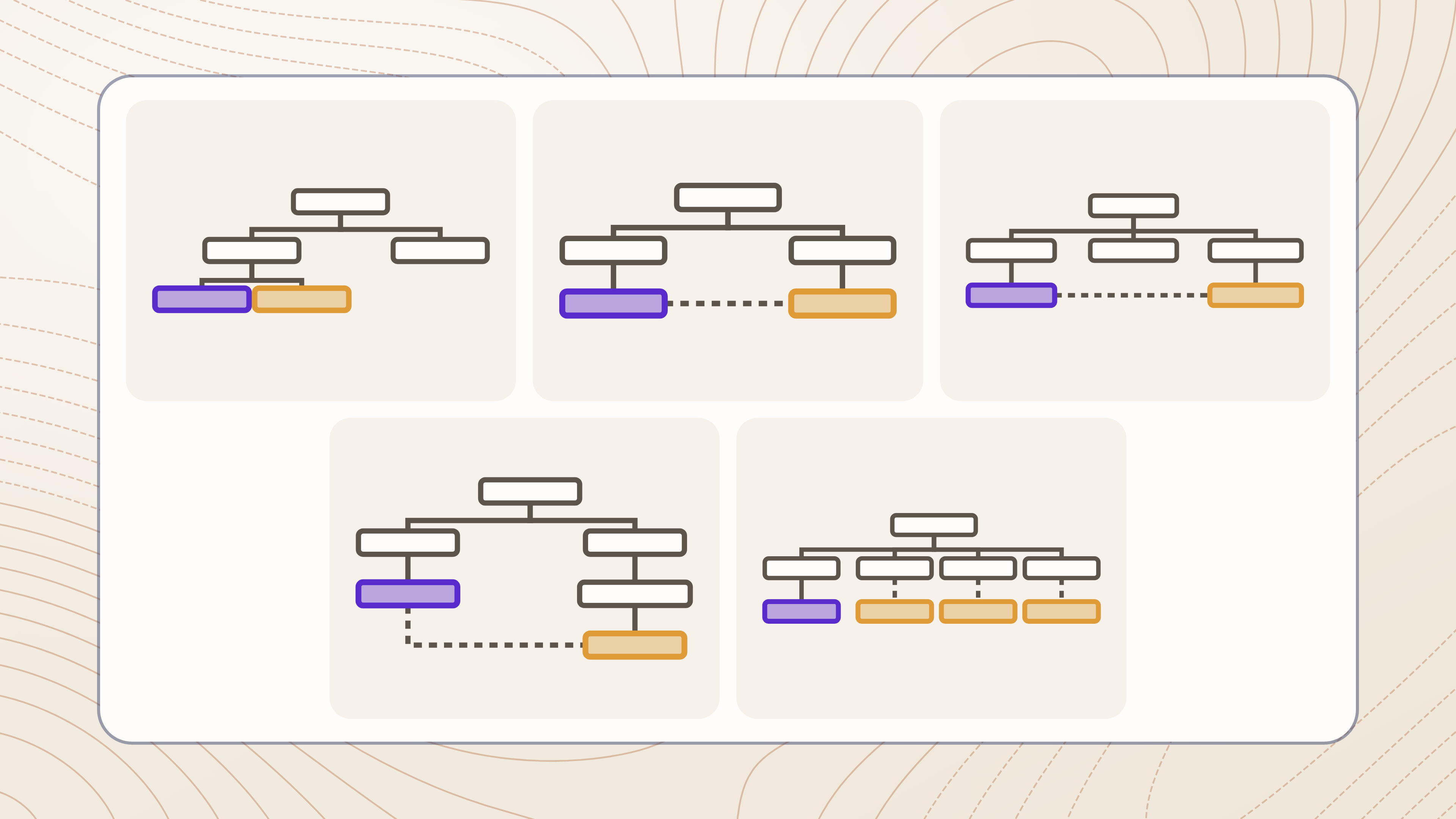
When every team builds and runs its own agents, those agents start to duplicate one another and sometimes conflict. At Skillable, the team is getting ahead of that overlap, using what agents actually do to decide which to expand, which to retire, and which repeated patterns should become canonical skills for the whole organization. This helps them avoid the problem of shelved or orphan agents.
Overlap rarely comes from a bad decision. Each team adds an agent for a sensible reason, and the estate grows one reasonable choice at a time until two agents are doing the same job with different access, different costs and sometimes no clear owner. The duplicated spend is the first thing people notice, but the more important problem is that nobody can say which version of the work the organization should rely on.
In practice, that means an owner and a defined job for each agent, consolidation where agents overlap, and deliberate retirement where the evidence says an agent no longer earns its cost. Retiring an agent on purpose is a far better outcome than losing a whole program because nobody could show what it delivered.
Prediction 4: Value data will move from the security team to the whole organization
In 2027, agent value data will reach the managers who own the work, alongside the teams who own the budget.
In most organizations today, agent value data sits with a small group, usually the AI and security leads. The next step is to share it more widely, first with the AI councils and governance groups that represent each part of the business, and then with the managers whose teams rely on the agents. Jessica calls the principle transparency for trust. Once budget controls are in place, the more useful insight is how spend is used, and when managers can see what their teams’ agents do and what they cost, each team can act on value directly, without waiting for a quarterly report from the AI lead.
This only works if the view covers every platform at once. The organizations we work with run agents across several ecosystems. Each platform reports on its own agents in its own way and a team leader rarely sees the full picture of what their agents are doing for them until that work is connected back to the people and teams who own it.
Prediction 5: Security and AI teams will own value together
In 2027, security teams’ responsibilities will extend into value, alongside AI teams, as both settle into a cross-functional AI governance motion.
Today, a lot of AI value work sits with AI and transformation teams, which makes sense while agents are still being introduced. As agents become part of everyday operations, security teams are taking on more of the value question too, because they already hold the evidence of what agents do and how they behave.
We expect the two to meet in a true AI governance motion, with AI teams bringing the use cases and outcomes, security bringing the evidence and controls, and finance, legal and business leaders joining the same conversation. “Governance works when everyone is looking at the same numbers,” Jessica says. “Then the conversation is about what to do next, not whose data is right.” That changes what the measures need to be: shared, durable and comparable from year to year, and built on one set of evidence that every function can rely on.
The definition of value and what the future holds
When we asked Jessica what it means for agents to deliver value, her answer was about people, not productivity. “The real return is what our people can do now that they couldn’t before,” she says. For her, value means giving people back the time that routine work consumes, so they can spend it where human judgment and creativity make the difference. Because that looks different in every department, measurement has to become more precise as agents take on more of the work, and her definition is the right test for every measure in this piece.
Looking further out, Jessica expects concepts like revenue per employee (RPE) and revenue per agent (RPA) to become the measures that matter most. Hours saved show what AI took off someone’s plate: RPE and RPA show what the business did with that time. Read together, they don’t show whether people or agents are doing more; they show how well the two work together to grow the business. The five predictions above are the stepping stones to getting there.
At Geordie, we think the organizations that get the most from agents next year will measure them like any other part of the workforce, by the work they do and what it’s worth. They’ll also treat security, cost and value as different readings of the same evidence.
About the authors
Jessica Zeba-Snow is Head of Product and Technology Operations and Programs at Skillable.
Hanah Darley is Co-founder and Chief AI Officer at Geordie.
References
- Microsoft Learn, Microsoft Copilot impact report, Viva Insights documentation, last updated August 2026.
- Microsoft 365 Roadmap, Agent value insights in Agent 365 Dashboard (ID 570847), published September 2026, updated October 2026.
- Joel Becker, Nate Rush, Beth Barnes and David Rein, METR, Measuring the Impact of Early-2025 AI on Experienced Open-Source Developer Productivity, July 2025; see also The Register’s coverage.
- Manuel Hoffmann, Sam Boysel, Frank Nagle, Sida Peng and Kevin Xu, Generative AI and the Nature of Work, Harvard Business School Working Paper 25-021; summarized in HBS Working Knowledge, Can AI Help Managers Love Their Jobs (Again)?, January 2025.